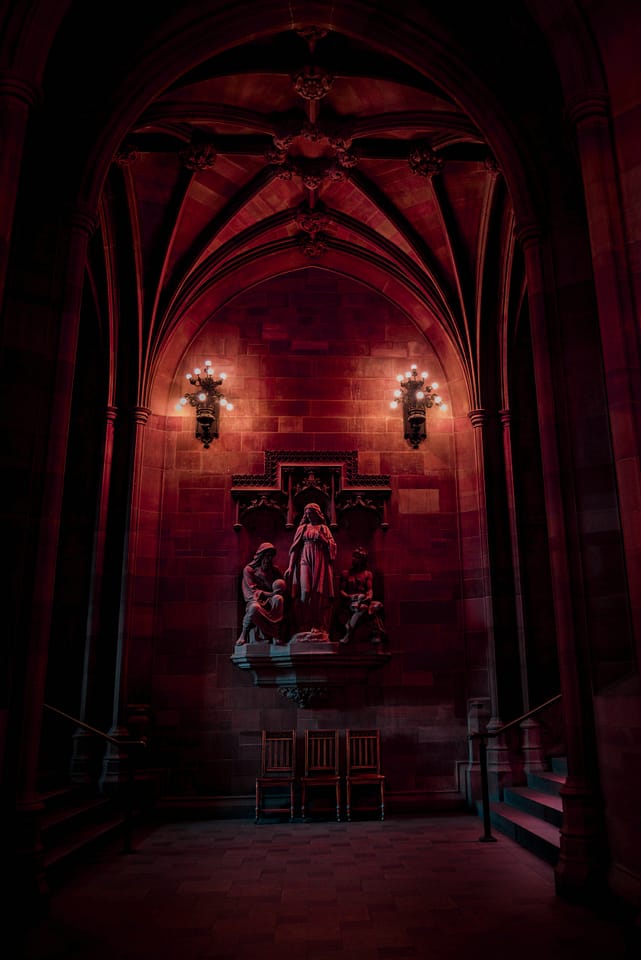
It was leaning more primordial ooze than river, shimmering and pulsing like a vein beneath a dying god’s thinning flesh. One narrow boat drove along, where a lone figure using one arm to drag the oar moving it forward at a steady pace. Half-eaten dead things bobbed grotesquely upon the surface of the lethargic course, while the scent of sweet incense hung heavily, along with something else. Something indefinable though hinting at burning wood.
“That is the smell of burning violins,” the figure said in a hollow voice, though chuckling as though there was some inside joke lurking there. “The River Styx has been that way since Rome fell.”
A young man sitting alone on the single bench at the center of the boat studied the figure at the helm, dazedly. He didn’t know how he knew, but the figure’s name was Charon. One-armed and unbothered, his hood stitched from the shadows of souls trapped in the middle realm, oaring a vessel carved from the bones of as big as a dinosaur… or dragon? An amber glow followed, though the boat bore no lanterns, as they drifted silently through what the young man guessed could only be an inky eternity. Nothing fore, nothing aft, yet everything, also. The young man was slowly forming questions because he felt he shouldn’t be there. Why was he? He hadn’t booked a boat ride.
“Why am I in a boat on the River Styx?” he asked dreamily.
“You made a poor choice,” Charon shrugged. “Based on nothing but your age. Unless… were you ill?”
“No. I don’t think so.”
“Ah,” Charon bowed its head for a moment. “Still, my condolences to you.” And the figure looked away, peering into whatever lay ahead, humming a tune that the young man found strange.
“What is that song? It feels familiar.”
Charon told him.
“Right, I love that song,” the young man shook his head. “Somehow I never imagined… never mind.”
Charon continued, singing the chorus of the song, a popular “Emo” tune from when the young man was in high school. The boat turned slightly off course and Charon struggled a little to move the oar to the other side to correct it. “Still getting used to that,” Charon mumbled. “And the pain… it isn’t comprehensive.”
“You’re missing an arm,” the young man said suddenly.
“I am.”
“That doesn’t seem right,” the young man said. “Who’d you piss off?”
Charon didn’t look back. “It was taken,” it said.
“Taken? By whom?”
“You’re an educated young man,” Charon said. “There are small points which often intensify the tragedy surrounding a bad choice.”
“University of Pittsburgh Medical,” the young man replied proudly. “I’m going to be a doctor.”
“Hmm,” Charon said, allowing the young man to catch up. “Anyway, it was not taken by war or by the gods. You probably won’t believe this, but it was music that took my arm.”
The young man blinked. “Music?”
“Like the song you recognized… Emo,” Charon said, the word falling like a curse. “It seems the genre of bleeding eyeliner eats its young.”
The boy leaned forward, intrigued. “Huh?”
Charon’s voice grew distant, like a radio tuned to a fading frequency.
“There was a time I sought more than ferrying souls. I wanted to feel. To scream. To wear pants so tight they would summon demons. I joined a band in those days. We weren’t half bad. The Weeping Willow and the Cosmic Regrets.”
The young man stifled a laugh.
“It’s not catchy, I know,” Charon went on. “But we were, how should I put it, distracted. Though I couldn’t sing, I played the guitar… with my now-lost arm. I can still see my tattoo of a broken hourglass and the words ‘They Hate Me.’ You know, for a while we struggled to get any gigs, as the halls were less friendly to our style of music.
“Emo?”
“Yes. That’s what we liked performing, you see. But then fate intervened, one super-fan sponsored us on a tour across the underworld. It was magical. We played cursed diners, abandoned settlements, ancient ruins. We were the toast of the ghost. Why did surf the crowd, that last show? Why! Folly is mine as legacy.”
“Folly?”
“How could I have known that terrible creatures were stalking me? I couldn’t have, of course. I crashed straight down and felt a snap and a tug, and the next thing I knew my arm had been taken by the spirit of teenage angst. Yes, yes, I know what you’re thinking. Why didn’t I try to retrieve it?”
“No, actually I wasn’t thinking that at all….”
“By the time I realized it had detached, there was another band on stage,” Charon said softly. “The Phantom Limbs.” The boat bumped something, and the young man saw they’d gone ashore. It was brown, gray, and non-descript, going as far as he could see. “We’ve come to your destination.” And Charon laid the oar down and extended one bony hand.
The young man reached into his pocket without hope and to his surprise found a coin. He pulled it out and laid it into Charon’s palm. Then, he stepped off the boat. “Thanks for the ride,” he said. “And the story.” He made a fist to show solidarity. “Emo forever.”
Charon nodded, an empty sleeve fluttering like a silver flag. Then the ferryman retrieved the oar and dragged offshore, rowing into the black whence they’d come, humming a tune that made the young man tap his toes and got stuck in his ear.

Mord McGhee
Mord McGhee is the author of Ghosts of the Girl: Anna’s Odyssey (Rezcircle Books USA), Ironblood (Golden Storyline Books UK), and The Stroke of Oars (Nat 1 Publishing USA) and is recently nominated for the Maya Angelou Book Award and Bram Stoker Award, and best known for pioneering work in the cyberpunk genre and work on feature films such as My Dead Friend Zoe (2024) and The Man in the White Van (2023).